When entering international markets, manufacturers need to know which regulations and standards apply in different countries. Non-compliance can lead to customs delays, product registration refusals, and fines.
Key International Regulations
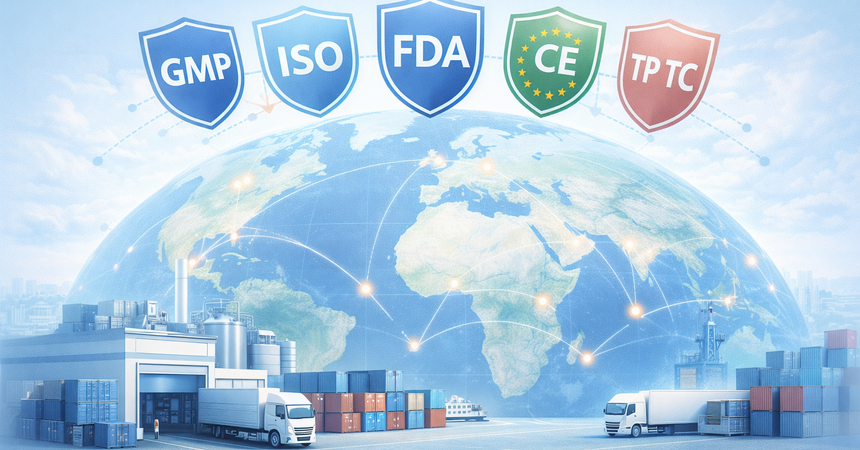
The following regulations are most often required for export:- GMP (Good Manufacturing Practice) – confirms that pharmaceutical, biotech, and medical products are produced according to international quality and safety standards.
- ISO (International Organization for Standardization) – quality management (ISO 9001), safety (ISO 45001), and food safety (ISO 22000) standards.
- HACCP (Hazard Analysis and Critical Control Points) – mandatory for food and beverage products, ensures critical safety points are controlled.
- TR TS (Technical Regulations of the Customs Union) – required for import and sale in Russia, Kazakhstan, and Belarus.
- FDA (Food and Drug Administration) – requirements for export to the USA, including pharmaceuticals, dietary supplements, and medical products.
- CE marking – required for certain goods exported to the European Union.
Regulations vary depending on the destination market:
- USA – FDA, ISO, GMP
- EU – EU GMP, ISO, CE
- Asia, Middle East, Latin America – PIC/S GMP, WHO GMP, ISO, HACCP
Advantages of Compliance
Compliance with international regulations provides significant benefits:- speeds up customs clearance and product registration
- reduces inspections and audits
- increases trust among partners and clients
- opens access to new markets
- improves internal processes and production standardization
Before entering a new market, manufacturers should:
- identify target countries and markets
- study regulatory requirements
- choose the appropriate regulations and standards
- assess production readiness for inspections
Conclusion
To successfully export products, it is essential to consider international regulations in advance. Compliance increases trust among regulators and partners, facilitates market entry, and reduces commercial and regulatory risks.If you plan to export products and want to determine exactly which regulations are required for your market, contact WorldWideBridge – we provide full preparation and turnkey support.